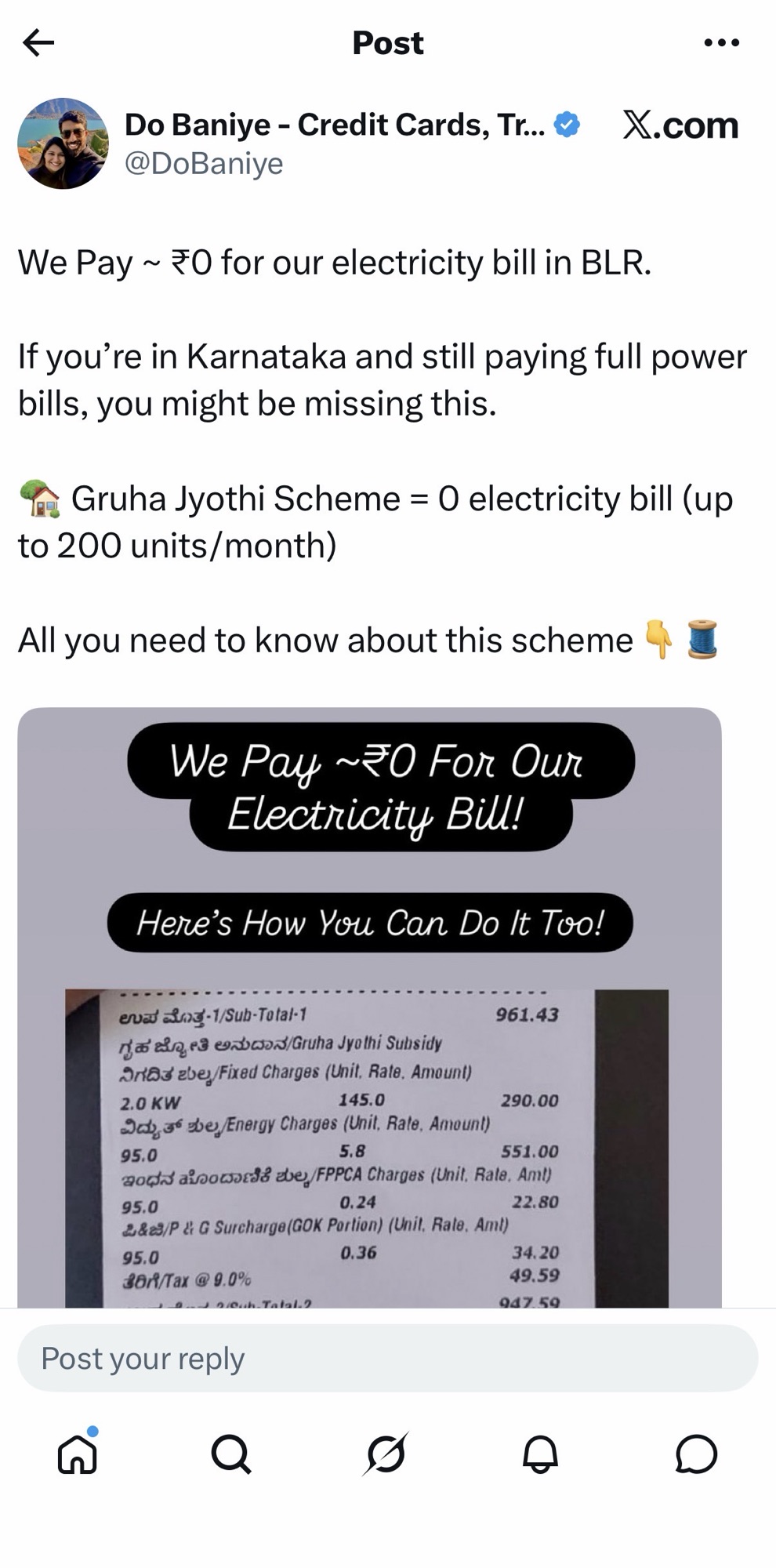
A recent social media post stopped me mid-scroll. A Bangalore resident, clearly comfortable enough to maintain a credit-card-and-travel lifestyle, proudly announced that their household now pays ₹0 for electricity. Thanks to Karnataka’s Gruha Jyothi Scheme, they receive free power up to 200 units a month. Rather than treating the subsidy as a quiet relief, they turned it into a public service announcement: “If you’re in Karnataka and still paying full bills, you might be missing this.”
I felt an odd mix of surprise and unease.
The scheme was designed as a safety net for families who genuinely struggle with basic needs. Yet here was someone who could easily afford the modest bill choosing to claim the benefit—and encouraging others to do the same. The post carried no hint of hesitation, no acknowledgment that every unit subsidised by the government is ultimately paid for by taxpayers. It was presented simply as a smart hack, complete with a screenshot and a thumbs-up emoji.
This is where freebie culture quietly reveals its deeper problem. When subsidies meant for the vulnerable become a lifestyle choice for those who don’t need them, the system begins to bend. Public funds that could strengthen the grid, improve supply reliability, or support genuine welfare get spread thinner. Over time, the state’s ability to deliver even basic services erodes—not because of malice, but because the culture of “why pay when you don’t have to” normalises itself.
What struck me most was the absence of any counter-emotion. No quiet pride in contributing one’s fair share. No sense that forgoing a subsidy one doesn’t desperately need might actually strengthen the social contract. Instead, the message was clear: smart citizens minimise their costs; only the naïve pay full price.
I wonder what kind of nation we become when the highest praise on social media is reserved for those who successfully avoid paying for public goods rather than those who willingly support them. True civic maturity isn’t measured by how cleverly one claims benefits. It lies in the quieter satisfaction of knowing one has paid the full cost without seeking a handout—freeing that limited resource for the neighbour who actually needs it.
Perhaps the real power saving isn’t in the monthly bill. It’s in choosing, day after day, to value self-reliance over entitlement. That choice may not trend as well online, but it might just be what keeps our collective future solvent and dignified.
Food for thought the next time a “₹0 bill” post crosses your feed.
 Anitva
Leave a comment