A Devil’s Advocate Analysis
“The road to irrelevance is paved with well-intentioned government mandates.”
India’s Open Network for Digital Commerce (ONDC) was born with an idealistic promise: to level the digital playing field for the 12–20 million kirana stores and small family businesses that form the backbone of Indian retail. The narrative was compelling — empower the neighbourhood grocer, the saree shop uncle, the hardware store aunty, give them a digital storefront, and watch them compete with Amazon and Flipkart. It sounds like a policy paper written by someone who has never actually tried to explain what an SKU is to a 58-year-old shop owner in a Tier-3 town.
This is not a critique of the intent of ONDC. The intent is noble. This is a hard, unflinching look at the premise — the assumption that small, family-run businesses can and will meaningfully digitalise their sales through a government-backed open protocol. The numbers, the ground reality, and the competitive landscape all tell a very different story. Let’s follow the thread.
The Romantic Myth of the Digitalised Kirana
The official story goes like this: India has over 12 million kirana stores. They are underserved, underrepresented in digital commerce, and starved of technology. ONDC will democratise access by giving them an open network with low commissions (5–8%, compared to 25–35% on Amazon/Flipkart), equal discoverability, and the ability to sell to customers beyond their immediate neighbourhood.
What the official story leaves out is the baseline condition of these stores. A typical kirana is under 500 sq ft, individually owned (97.5% of all retail establishments in India are single-owner operations), and stocks roughly 1,000–1,500 SKUs. More than 80% of India’s retail stores are still predominantly cash-intensive. They run on trust, personal credit, and the owner’s memory. There is no inventory system. There is no SKU master. There is no barcode scanner. There is often no reliable internet connection.
The question ONDC never adequately answered is this: before you can digitise a business, the business itself needs to be operating in a somewhat structured, data-generating manner. It doesn’t. And that is not a solvable problem with an app.
Problem #1: No POS, No Inventory — No Foundation to Build On
The single most catastrophic flaw in the ONDC thesis is that it assumes a digital inventory exists to be plugged into the network. It doesn’t.
In India, only about 12% of offline sellers update their inventory daily using any digital method. The vast majority of kirana owners maintain their stock knowledge in their heads, on paper notebooks, or through the simple act of looking at a shelf. When a product runs out, they call the distributor. There is no perpetual inventory system, no real-time stock count, no digital product catalogue.
This creates an unavoidable operational crisis the moment any order comes in through ONDC. The digital listing says a product is available. The physical shelf may tell a different story. The result is what supply chain professionals call a fill rate problem — the gap between orders placed and orders actually fulfilled. ONDC seller onboarding material itself acknowledges frequent seller-side cancellations due to unavailable stock. When your primary seller base runs its inventory on experience rather than data, a fill-rate crisis is inevitable.
Worse, the solutions proposed — warehouse management systems, real-time stock sync, barcode scanning — require an upfront investment in hardware, software, training, and process change that is economically irrational for a store turning over ₹30,000 a month. You are asking a store owner to spend money they don’t have to solve a problem they don’t currently face.
Problem #2: The SKU Cataloguing Mountain Is Unclimbable for a 2-Person Shop
Before a single product can be discovered by a buyer on any ONDC buyer app, it must be catalogued. Every item needs an online name, a category mapping, a price, a description, a photograph, and a unit of measurement — all mapped to ONDC taxonomy standards. A typical kirana store carries 1,500–3,000 SKUs.
Now picture the average kirana owner. He is likely above 45 years of age, managing the store largely on his own or with a family member. He is running the shop, managing credit, receiving distributor deliveries, and keeping the lights on simultaneously. You are asking this person to spend hours cataloguing thousands of products — with photographs — inside a seller app that demands category precision and variant configuration.
ONDC’s own seller onboarding documentation acknowledges that convincing sellers to sell online is a core challenge. Seller apps have resorted to extensive vernacular training material just to complete KYC and basic catalogue creation. Even then, only a minority of registered sellers maintain fully updated catalogues. Listing is not activity. Registration is not participation.
The incentive structure compounded the problem. Seller apps were rewarded for onboarding volume, not for sustained seller activity. Predictably, onboarding surged, liquidity did not. The outcome has been high seller churn, inconsistent catalogue quality, and degraded consumer trust.
Problem #3: Digital Literacy Is Not Where It Needs to Be — And It Won’t Get There Fast Enough
Every digital transformation programme rests on the assumption that its target users have the capacity to adopt digital tools. In this case, that assumption collapses quickly.
Less than two-thirds of urban Indians and well under half of rural Indians are digitally literate. Only a small fraction of the population above 15 possesses basic ICT skills. Studies examining ONDC adoption consistently point to digital literacy as the dominant barrier across MSMEs.
Industry surveys paint a similar picture. A majority of MSME owners struggle to even identify suitable digital tools, and an overwhelming proportion are unaware of government digitalisation schemes altogether. The programme is functionally invisible to most of its intended beneficiaries.
UPI is often cited as proof that digital adoption can happen en masse. This is a flawed comparison. Scanning a QR code is cognitively trivial compared to managing a live catalogue, responding to orders, meeting SLAs, handling returns, and resolving disputes. Conflating the two leads to bad policy conclusions.
Problem #4: Do Small Store Owners Even Want This?
A question rarely asked — but central to the issue — is whether kirana owners actually want to become digital sellers.
The evidence suggests hesitation at best. Not due to technophobia alone, but because of opportunity cost. A physically present store serving walk-in customers already operates a zero-acquisition-cost sales channel. ONDC adds operational overhead: monitoring apps, confirming orders, packing goods, coordinating delivery. That is not incremental income. It is incremental labour.
Surveys reporting high willingness among SMBs to invest in online sales capture aspiration, not behaviour. Wanting growth is not the same as accepting fundamental operational restructuring. In practice, most owners decline the latter.
Problem #5: The Numbers Don’t Lie — ONDC Retail Is Collapsing
If ONDC’s retail thesis were working, the data would show it. It doesn’t.
Retail transactions peaked in late 2024 and declined sharply over the following months. By mid-2025, volumes had fallen to a one-year low. Retail’s share of total ONDC transactions has shrunk materially.
The commonly cited reason — reduction of financial incentives — is not a defence; it is an indictment. Incentives had artificially propped up behaviour that disappeared once subsidies stopped. Adoption driven purely by cash flow is not adoption.
Several major buyer-app partners have since reduced visibility or exited entirely. Those are strategy decisions, not implementation glitches.
Problem #6: Quick Commerce Has Already Won the Consumer Mind
Even if ONDC solved every supply-side issue tomorrow, demand would remain the core problem.
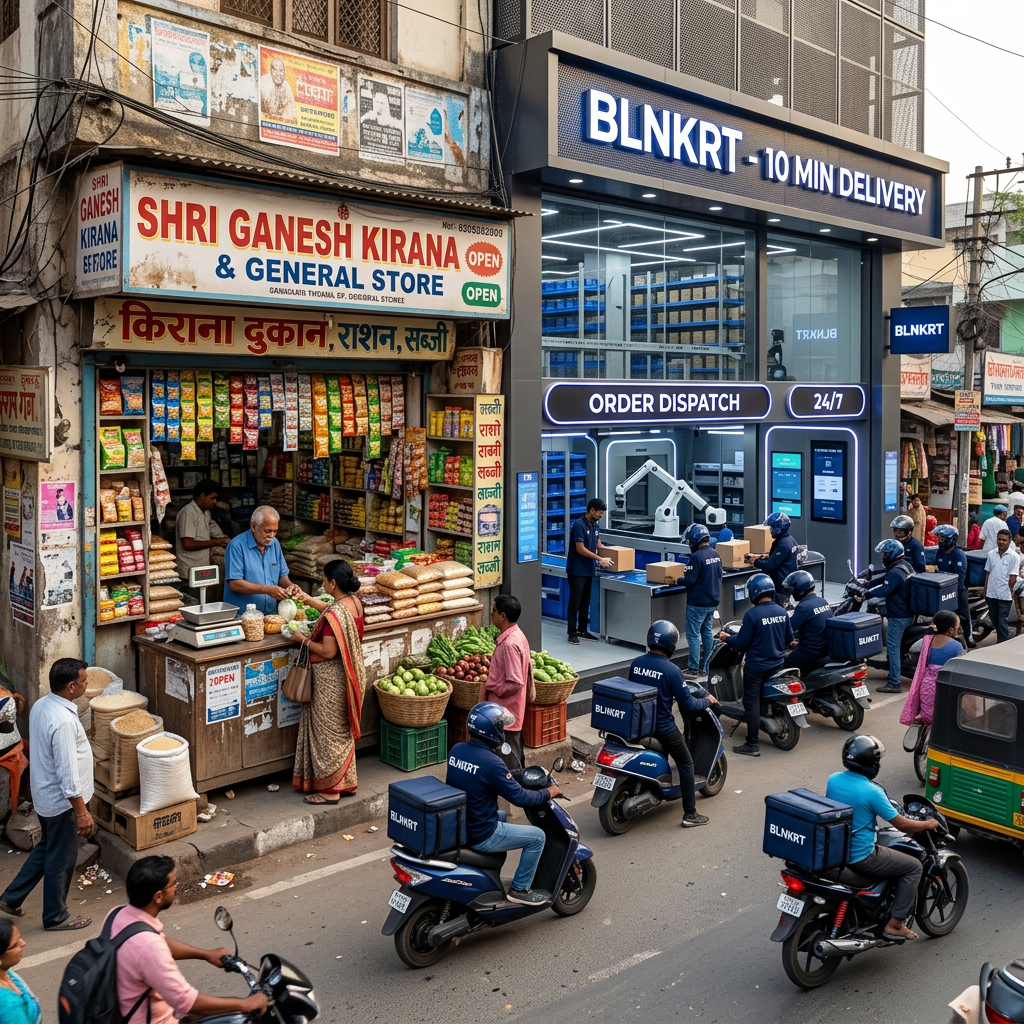
Consumers today inhabit a world shaped by quick commerce. Blinkit, Zepto, and Instamart deliver in minutes, offer thousands of SKUs, provide polished UX, and enforce predictable service levels. They operate dark stores, professional logistics, and algorithmic reordering.
ONDC, by contrast, continues to struggle with fragmented listings, unreliable fulfilment, and inconsistent support. For consumers accustomed to 10-minute delivery, ONDC represents friction without advantage.
The market has already made its choice.
Problem #7: The Structural Mismatch Between Open Protocol and Physical Reality
ONDC is often compared to UPI. The comparison is misleading.
UPI standardised a fully digital process — bank-to-bank communication. ONDC attempts to standardise deeply physical systems: inventory, packing, dispatch, last-mile delivery. Protocols cannot manufacture operational capability.
This gap — between digital intent and physical execution — is where ONDC consistently falters.
Problem #8: The “Onboarded” Seller Is Largely a Fiction
Headline onboarding numbers sound impressive. They are also misleading.
Order volume is concentrated among a relatively small cohort of organised sellers. The long tail — the kiranas — remains largely inactive. Incentives encouraged registration, not retention. A large portion of sellers exist only on dashboards, not in transactions.
The Hard Truth Nobody Wants to Say
ONDC correctly identified a problem: platform concentration and rent extraction. Its solution — an open protocol — is technically sound.
But it misidentified the beneficiary. ONDC works for businesses that already have catalogues, processes, and digital maturity. It does not work for two-person family retail shops.
The kirana does not need ONDC. It needs foot traffic, trust, and UPI. Anything more is additive labour with uncertain payoff.
The Quick Commerce Verdict
While ONDC retail volumes declined, quick commerce attracted billions in funding, expanded logistics infrastructure, and scale rapidly.
These platforms are not competing with kiranas on ideology. They are competing on execution.
ONDC asks kiranas to compete without the tools, time, or incentives to do so.
Conclusion: Honest Reckoning Over Hopeful Narratives
ONDC is not useless. Its protocol has viable applications across sectors.
But its flagship promise — digitising kiranas to make them competitive in a 10-minute economy — is structurally flawed. It ignores:
- Missing digital inventory foundations
- Unsustainable operational load on micro-shops
- Deep digital literacy constraints
- Weak intrinsic seller motivation
- A vast UX gap versus incumbents
- Clear evidence of post-subsidy collapse
India’s small retailers will endure — as they always have — through trust, credit, and proximity. Their future will not be decided by seller app taxonomies or open protocols.
The sooner this is acknowledged, the sooner ONDC’s real strengths can be applied where they actually work.
The author takes no pleasure in this conclusion. But a wrong diagnosis, however well-intentioned, produces a wrong cure.


Leave a comment